

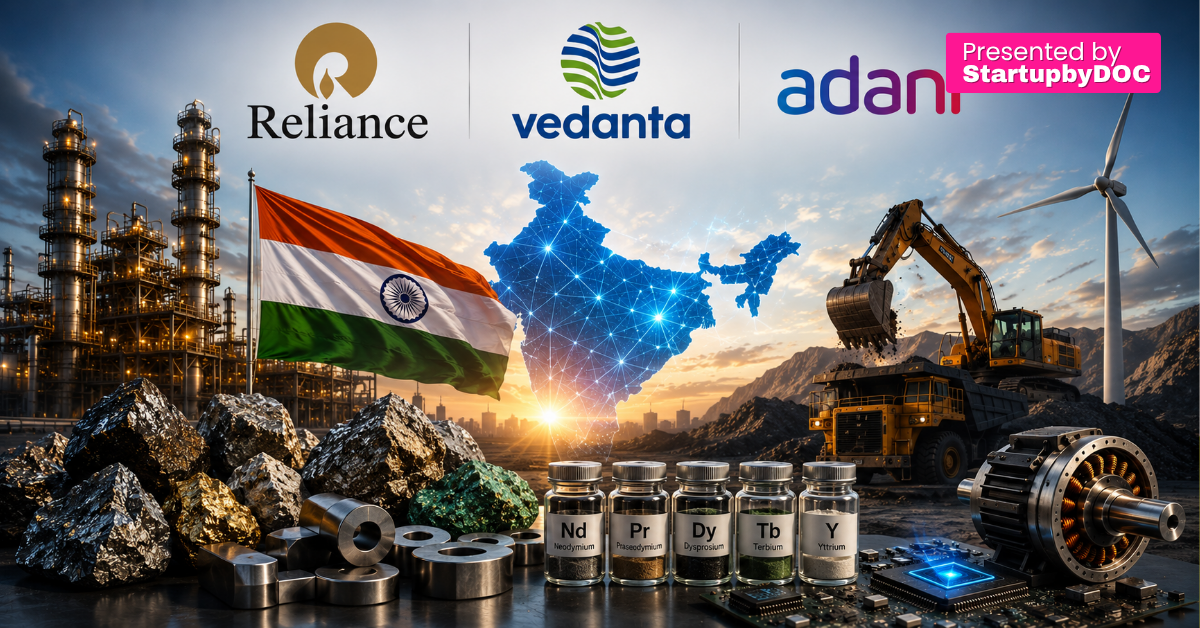
Reliance Industries, Vedanta, and Adani Enterprises have emerged among the leading companies exploring investments in India’s rare earth sector, as the country accelerates efforts to reduce its dependence on China for critical minerals essential to modern industries.
According to reports, the three conglomerates are among nearly 10 companies that have expressed interest in setting up rare earth processing facilities in Andhra Pradesh, a state that holds some of India’s largest reserves of rare earth-bearing minerals. The development marks a significant step in India’s strategy to build a domestic supply chain for critical minerals used in electric vehicles, renewable energy systems, electronics, semiconductors, and defense technologies.
The move comes amid growing global competition for critical minerals and increasing concerns over China’s dominance in the rare earth supply chain.
Andhra Pradesh Emerges as Rare Earth Hub
At the center of the initiative is Andhra Pradesh, which possesses an estimated 211 million metric tons of beach sand mineral resources, including rare earth deposits spread across 16 identified coastal locations. The state government is actively working to attract investments in mining, processing, refining, and downstream manufacturing.
According to a draft government document, Andhra Pradesh aims to attract nearly ₹50,000 crore ($5.2 billion) in rare earth and titanium-related investments over the next decade. The state is expected to launch project tenders after receiving cabinet approval for its rare earth corridor policy.
Officials are also considering capital-linked incentives and additional benefits for large-scale projects, particularly those involving investments exceeding ₹1,000 crore.
Why Rare Earth Minerals Matter
Rare earth elements play a critical role in manufacturing permanent magnets used in electric vehicle motors, wind turbines, advanced electronics, defense systems, and industrial machinery. Despite possessing significant reserves, India currently lacks large-scale processing infrastructure capable of refining rare earth minerals into high-purity products.
China currently dominates global rare earth processing, giving it significant influence over industries that rely on these strategic materials. This has prompted governments worldwide to diversify supply chains and develop domestic capabilities.
For India, developing a complete rare earth ecosystem is increasingly being viewed as both an economic and strategic priority.
Government Backing Strengthens Industry Interest
The interest from Reliance, Vedanta, and Adani follows several policy measures announced by the central government to boost domestic critical mineral production. In the Union Budget 2026, the government proposed dedicated rare earth corridors across Andhra Pradesh, Odisha, Kerala, and Tamil Nadu. The initiative builds on earlier efforts to support rare earth magnet manufacturing and strengthen India’s critical mineral supply chain.
Industry experts believe participation from some of India’s largest industrial groups could accelerate investment, technology adoption, and infrastructure creation across the sector.
As global demand for critical minerals continues to rise, India’s rare earth ambitions could become a key pillar of the country’s manufacturing, energy transition, and technology growth strategy over the coming decade.