


India’s direct-to-consumer (D2C) ecosystem has evolved considerably over the past few years. As brands compete for consumer attention across digital platforms, scaling an ecommerce business is no longer simply about increasing advertising budgets or generating more online sales.
For many D2C founders, the bigger challenge lies in balancing revenue growth with customer acquisition costs, advertising efficiency, return-to-origin (RTO) rates and long-term profitability.
A brand may report impressive sales figures and a healthy return on advertising spend (ROAS), yet struggle to translate those numbers into sustainable business growth.
This shift is changing what businesses expect from their performance marketing partners.
Mumbai-based Sqroot Media Private Limited is building its approach around this challenge, positioning itself as an AI-enabled, D2C-focused performance marketing agency that connects advertising strategy with broader business economics.
Why ROAS Alone Is No Longer Enough for D2C Brands
For years, ROAS has been one of the most widely discussed metrics in performance marketing. While it remains important, relying on it in isolation can create an incomplete picture of business performance.
A D2C brand generating 4X ROAS, for example, may still face profitability challenges when product margins, logistics costs, discounts, payment charges and returned orders are considered.
Similarly, rapidly increasing advertising expenditure may generate higher revenue while putting pressure on customer acquisition efficiency.
Sqroot’s approach is built around understanding these interconnected metrics rather than treating advertising performance as a standalone function.
The agency focuses on indicators such as net ROAS, customer acquisition cost (CAC), conversion rates, average order value (AOV), repeat purchase behaviour and return-to-origin rates.
The objective is to help brands assess not only how much revenue their advertising generates, but also how efficiently that revenue contributes to sustainable growth.
For growing D2C businesses, this represents an important distinction: scaling revenue and scaling profitably are not always the same thing.

Building a Growth Strategy Beyond Media Buying
Traditional performance marketing often concentrates on campaign execution, audience targeting and advertising optimisation.
Sqroot’s operating model extends beyond these activities by examining the customer journey from the first advertisement interaction to the final purchase and subsequent customer retention.
Its services include performance marketing across Meta Ads and Google Ads, marketplace advertising, creative strategy, conversion rate optimisation, analytics and retention-focused initiatives.
Rather than viewing each function independently, the agency aims to identify opportunities across the entire ecommerce funnel.
For example, when a campaign generates traffic but produces limited sales, the underlying problem may not necessarily be the advertisement.
It could involve product-page experience, website loading speed, pricing communication, checkout friction or a mismatch between advertising messaging and customer expectations.
Addressing such issues requires coordination between media buying, creative strategy, analytics and website optimisation.
This broader approach is particularly relevant for established D2C businesses seeking to scale their advertising budgets without allowing acquisition costs to increase disproportionately.
Combining AI and Creative Strategy to Improve Advertising Efficiency
As digital advertising becomes increasingly competitive, creative differentiation has emerged as an important factor influencing campaign performance.
Consumers encounter numerous advertisements across social platforms every day, making it harder for brands to consistently capture attention and communicate their value proposition.
Sqroot incorporates AI-enabled creative production and user-generated content (UGC)-style advertising into its performance marketing offering.
The approach is designed to help brands experiment with different advertising concepts, product demonstrations, messaging formats and audience-specific creatives while reducing reliance on lengthy traditional production cycles.
However, the agency’s approach is not simply about producing more advertisements.
The emphasis is on using performance data to understand which creative concepts resonate with different customer segments and refining campaigns accordingly.
Creative experimentation, when combined with audience insights and conversion data, can help brands make better-informed decisions about where to allocate advertising budgets.
For D2C founders, the potential advantage lies in developing a repeatable process for creative testing rather than depending on occasional high-performing campaigns.
From Customer Acquisition to Customer Lifetime Value
Another challenge facing D2C brands is the increasing importance of extracting greater value from acquired customers.
Acquiring a customer is only the beginning of the relationship. Repeat purchases, retention, customer experience and fulfilment efficiency can significantly influence the overall economics of an ecommerce business.
Sqroot’s growth framework incorporates these considerations through conversion optimisation, customer journey analysis and retention-focused strategies.
The agency also examines metrics such as prepaid order ratios and return-to-origin rates, particularly relevant for Indian ecommerce businesses where cash-on-delivery orders and fulfilment-related losses can affect profitability.
By connecting acquisition performance with post-purchase outcomes, the agency seeks to provide brands with a more comprehensive understanding of marketing effectiveness.
This approach also highlights an important reality for D2C businesses: increasing advertising spend is not always the most effective route to growth.
In certain situations, improving website conversion rates, increasing repeat purchases or reducing avoidable order losses can improve business performance without requiring a proportionate increase in customer acquisition expenditure.
What Sqroot’s Published Case Studies Indicate
Sqroot’s publicly available case studies illustrate how its performance marketing approach has been applied across consumer categories including fashion, beauty, skincare and food and beverage.
For athleisure brand Athflex, Sqroot reports scaling monthly sales from approximately ₹25 lakh to ₹1 crore, with acquisition and retention campaigns contributing differently to overall advertising returns.
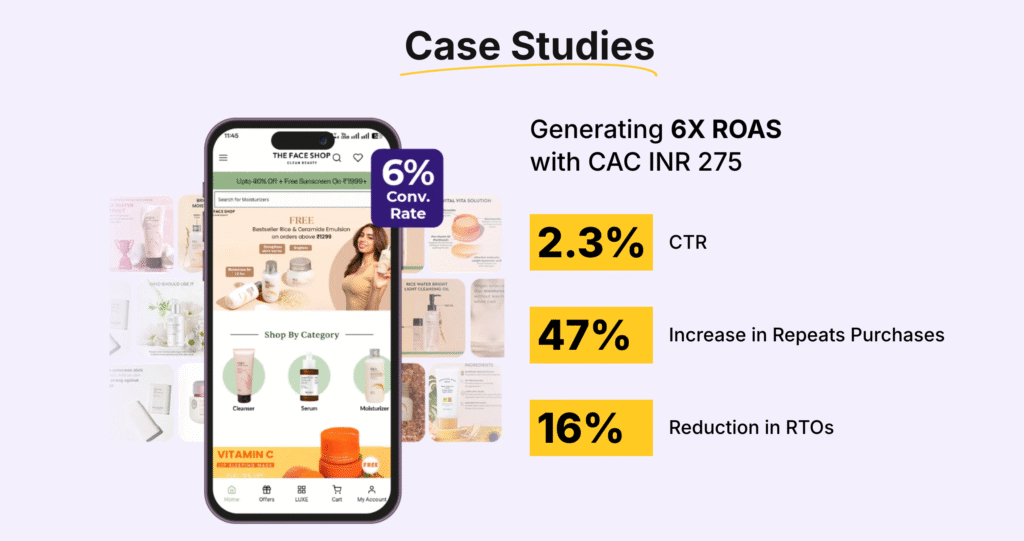
Its published work involving skincare brand The Face Shop highlights a reported 5X return on advertising spend alongside website conversion and customer acquisition metrics.
Other examples on the agency’s website reference improvements in repeat purchases, prepaid orders, conversion rates and return-to-origin performance across different D2C businesses.
These outcomes are company-reported, and individual results depend on factors including advertising budgets, campaign duration, product economics, market conditions and customer behaviour.
Nevertheless, the case studies reflect Sqroot’s emphasis on evaluating performance through multiple business metrics rather than advertising returns alone.
The agency’s website states that it serves more than 50 active customers and showcases experience across several consumer-focused categories.
Extending Performance Expertise Beyond D2C
Although D2C ecommerce remains a central area of focus, Sqroot also works across real estate, banking and financial services (BFSI), and education technology.
These sectors require different approaches to measuring marketing effectiveness.
While ecommerce businesses often prioritise purchases, customer acquisition costs and repeat orders, lead-generation businesses must evaluate lead quality, conversion rates and the eventual cost of acquiring paying customers.
A campaign delivering inexpensive leads, for instance, may not necessarily deliver strong business outcomes if those leads fail to convert into qualified prospects or customers.
Sqroot’s broader performance marketing approach therefore focuses on aligning advertising objectives with the commercial realities of each industry.
Its advertising capabilities also extend to ecommerce marketplaces and quick-commerce platforms, reflecting the growing number of digital channels through which brands reach consumers.
The Changing Role of Performance Marketing Agencies
The growing complexity of digital commerce is gradually reshaping the relationship between brands and their marketing agencies.
Businesses increasingly need partners capable of understanding how marketing decisions affect revenue, customer acquisition efficiency and profitability.
This creates a more strategic role for performance marketing agencies, extending beyond campaign management and monthly advertising reports.
For D2C founders, questions around sustainable scaling are becoming increasingly important.
How much can advertising expenditure increase before acquisition efficiency begins to decline? Which customer segments offer the strongest long-term value? Are improvements in ROAS translating into healthier business economics? Could conversion improvements deliver greater returns than additional media spending?
These are questions that require a combination of advertising expertise, analytics, creative experimentation and commercial understanding.
Sqroot’s positioning reflects this broader direction, bringing together performance marketing, AI-enabled creative production, conversion optimisation and customer retention strategies.
Looking Ahead: Profitable Growth as the Real Performance Metric
As India’s D2C ecosystem continues to mature, the definition of successful performance marketing is expanding.
Advertising platforms remain important growth channels, but sustainable expansion increasingly depends on how effectively businesses connect customer acquisition with conversion efficiency, repeat purchases and operational economics.
Sqroot is seeking to address this challenge through an integrated performance marketing approach designed around measurable business outcomes.
For brands evaluating growth partners, the distinction may ultimately come down to whether an agency can move beyond optimising advertising dashboards to understanding the economics behind them.
The future of D2C performance marketing may not be defined by who can spend the most on advertising, but by who can turn advertising investments into the most sustainable business growth.
For more information about Sqroot’s approach to D2C performance marketing, visit Sqroot.