

For decades, Indian agriculture has faced a difficult equation. Rising input costs, declining soil fertility, unpredictable weather, and shrinking margins have pushed many farmers to abandon cultivation altogether.
Yet, in Maharashtra’s drought-prone Solapur district, one engineer saw an opportunity where others saw a challenge.
Sagar Khare, a mechanical engineer from Kurduwadi village, was working as a Project Engineer at global automotive giant Adient. Like thousands of professionals, he had what many considered a secure corporate career. But in 2019, he made a decision that surprised everyone around him.
He quit his multinational job and returned to farming.
Why Did Sagar Khare Leave His Corporate Career?
The decision was driven by what he witnessed on his family’s farmland.
Traditional cultivation of sugarcane, wheat, and chickpeas relied heavily on chemical fertilizers and pesticides. Costs were increasing every year while soil quality continued to decline. Despite hard work, profitability remained limited.
Instead of continuing the cycle, Sagar began studying sustainable and organic farming models that could generate higher returns while improving soil health.
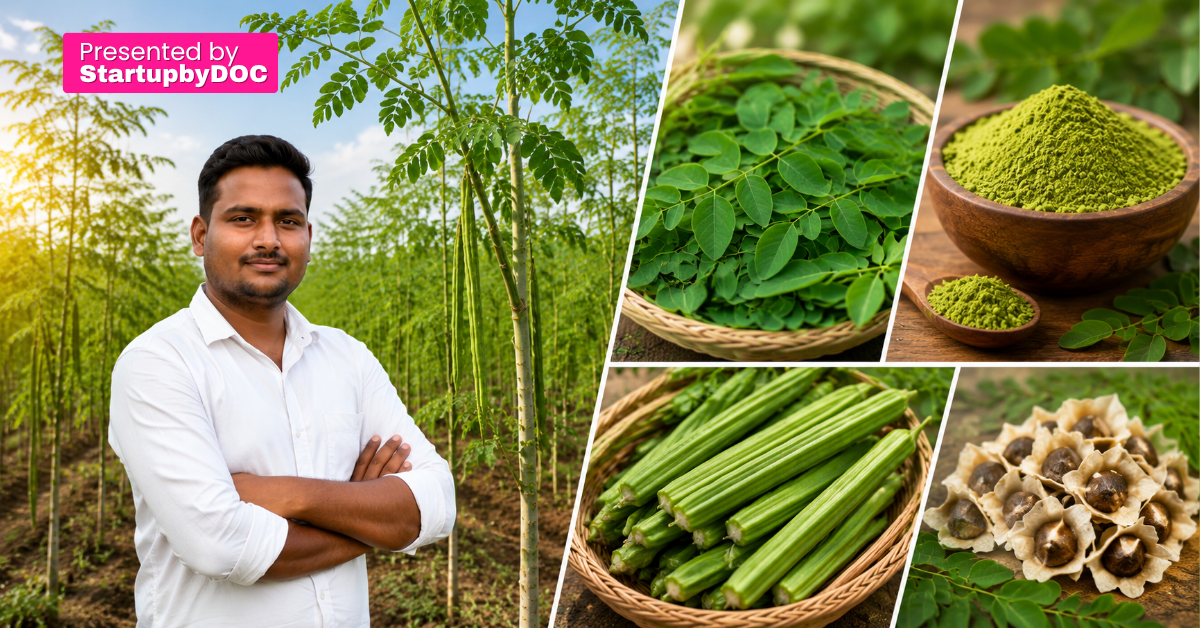
His research led him to moringa, commonly known as drumstick.
How Did Moringa Become A Profitable Farming Business?
Sagar selected the ODC3 moringa variety, known for its resilience in hot and dry climates.
He strategically divided his 5-acre farm:
• 4 acres dedicated to drumstick pod production
• 1 acre dedicated to moringa leaf cultivation
Rather than selling only raw produce, he focused on multiple revenue streams.
The leaves were processed into moringa powder, a nutrient-rich product with growing demand in domestic and international markets. Seeds were sold to other farmers, while fresh pods generated consistent income throughout the year.
This diversified approach transformed a simple crop into a scalable agricultural business.
What Are The Numbers Behind The Success?
Today, Sagar’s moringa venture generates approximately ₹36 lakh in annual turnover.
The revenue breakdown includes:
• ₹17 lakh from drumstick pods
• ₹12 lakh from moringa leaf powder
• ₹7 lakh from moringa seeds
After operational expenses, the business reportedly delivers around ₹30 lakh in net profit, translating to nearly ₹6 lakh profit per acre.
For a region often associated with water scarcity and farming challenges, these numbers highlight the potential of high-value agriculture.
How Does Organic Farming Play A Key Role?
A major part of Sagar’s success comes from reducing dependency on external inputs.
He shifted completely toward organic practices, using green manure, vermicompost, and natural fertilizers produced through his own livestock. This improved soil fertility while lowering long-term cultivation costs.
The result is a farming system designed for sustainability rather than short-term yield maximization.
What Can Entrepreneurs Learn From This Journey?
Sagar Khare’s story is not simply about agriculture.
It is about identifying an overlooked opportunity, building multiple revenue streams, and creating value through innovation.
While many chase opportunities in cities and technology sectors, his journey proves that entrepreneurship can emerge from fields, farms, and rural communities as well.
The future of India’s startup ecosystem may not be limited to software and AI. Sometimes, it begins with a farmer willing to rethink a traditional industry.