

Why Did The Founders Start Sweet Karam Coffee?
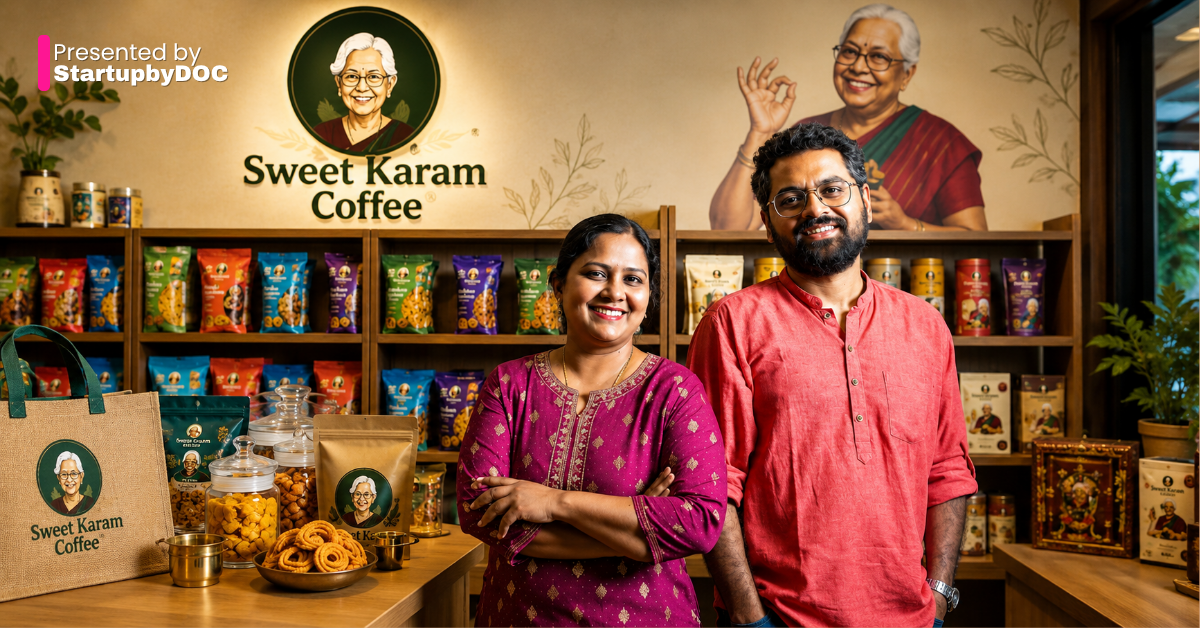
India’s packaged food market has expanded rapidly over the last decade, but much of that growth has been driven by products loaded with preservatives, palm oil, and artificial ingredients. At the same time, authentic South Indian snacks remained fragmented and difficult to access beyond local markets. Sensing this opportunity, Nalini Parthiban, Anand Bharadwaj, Veera Raghavan and Srivatsan Sundararaman launched Sweet Karam Coffee in 2015 from a home kitchen in Chennai with an investment of just ₹2,000. Their mission was simple: bring traditional South Indian flavors to modern consumers while preserving authenticity and quality.
How Did They Win Their First Customers?
The founders had no large marketing budget and relied on grassroots efforts to build awareness. They distributed newspaper pamphlets, managed deliveries themselves, and personally engaged with customers to understand their preferences. As product quality drove repeat purchases, word-of-mouth referrals became their biggest growth engine. A major turning point came with the introduction of Janaki Paati, the brand’s grandmother-inspired mascot. Representing trust, nostalgia, and homemade cooking, Janaki Paati became the face of the company and helped Sweet Karam Coffee stand out in an increasingly crowded food market.
How Did Sweet Karam Coffee Build A Distinct Brand?
As customer demand grew, the company expanded beyond snacks into sweets, filter coffee, ready-to-cook mixes, pickles, and regional specialties. What truly differentiated the brand was its commitment to clean-label products. Every item was prepared with a strict promise of no palm oil, no maida, no preservatives, and no artificial additives. This approach resonated strongly with consumers seeking healthier alternatives without compromising on taste. By combining traditional recipes with modern packaging and convenience, Sweet Karam Coffee created a unique position in India’s growing direct-to-consumer food market.
How Did The Startup Scale Across India And Globally?
After establishing product-market fit, the founders focused on expanding distribution. The company adopted a digital-first approach through its direct-to-consumer platform while leveraging quick-commerce and e-commerce channels to reach customers nationwide. Today, the brand ships products to more than 30 countries, serving the growing Indian diaspora seeking authentic regional foods. This omnichannel strategy enabled Sweet Karam Coffee to evolve from a Chennai-based kitchen venture into a nationally recognized food brand with international reach.
What Turned A Small Kitchen Venture Into A ₹580 Crore Company?
The financial growth tells the story of successful execution. Revenue increased from ₹1.7 crore in FY23 to ₹11.2 crore in FY24, before surging to ₹46.4 crore in FY25. The company also crossed a remarkable ₹100 crore annualized revenue run rate, reflecting strong consumer demand and rapid expansion. Investors including Peak XV Partners and Fireside Ventures backed the startup with nearly $15 million in funding, helping strengthen operations and accelerate growth. Today, Sweet Karam Coffee is valued at approximately ₹580 crore. Its journey proves that founders do not always need groundbreaking technology or massive capital to build a successful company. Sometimes, a deep understanding of culture, consistent execution, and a commitment to authenticity can transform a ₹2,000 home-kitchen experiment into a ₹100 crore brand.