

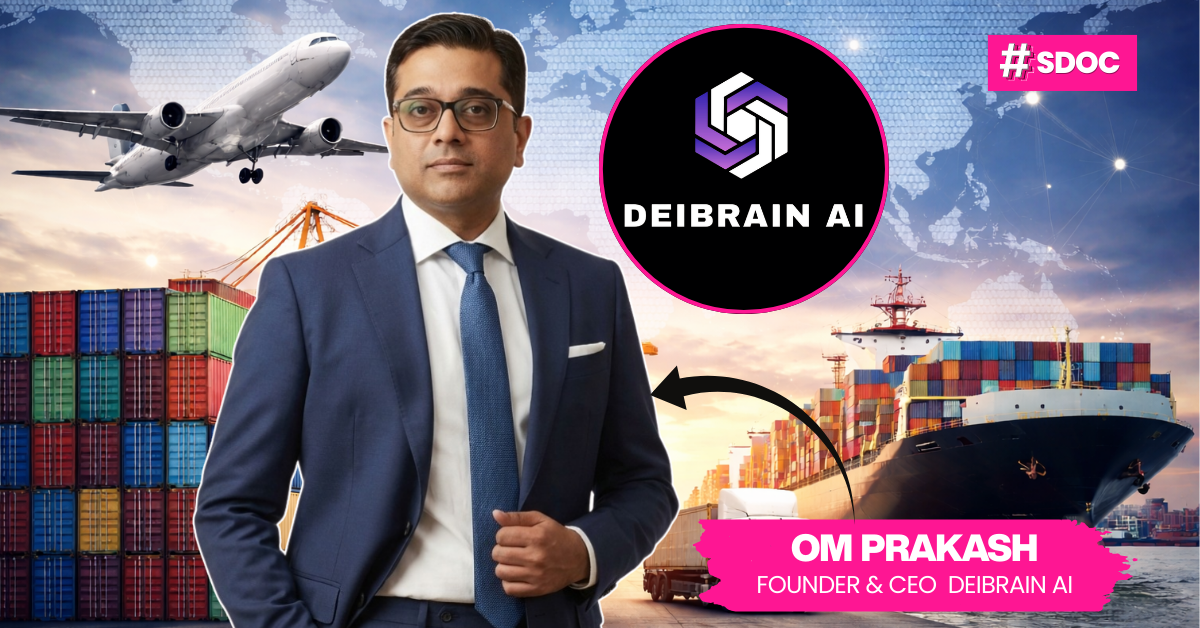
In India and across global trade corridors, supply chains rarely break because of one dramatic event. More often, they slow down through delayed shipments, tariff shifts, demand volatility, rising logistics costs, and fragmented vendor coordination. Most enterprise systems can report what went wrong, but they usually stop at analysis. That leaves companies reacting after disruption has already affected procurement, production, or fulfilment.
The Founder and the Early Challenge
That gap is what Om Prakash set out to address with DEIBRAIN AI. Instead of building another analytics layer on top of ERP systems, he focused on creating what the company positions as an Agentic AI brain for supply chains. The challenge was not only technical. It was also about enterprise trust. Businesses are familiar with software that supports decisions, but far fewer are ready for systems that autonomously simulate disruptions, negotiate with partners, and optimize operations in real time.
What the Startup Built Differently
DEIBRAIN AI treats supply chains as an execution problem, not only a visibility problem. Its suite includes NeuroChain AI for self-healing supply chain intelligence, 360° OS for turning waste streams and ESG opportunities into measurable value, and TariffShield AI for managing tariffs, sanctions, and geopolitical risk. Together, these products are designed to move beyond dashboards toward autonomous action across manufacturing, procurement, logistics, and trade routes.
Strategic Relevance in the Indian Context
For Indian founders, the lesson is practical. Large sectors may already be crowded with software, but many still have deep execution gaps. DEIBRAIN AI’s positioning shows that the opportunity often lies not in creating more reports, but in building systems that respond faster when conditions change. In operational sectors where inefficiency scales quickly, that difference matters.
The Larger Lesson
DEIBRAIN AI’s story is less about hype and more about product direction. In complex sectors, the real edge comes from building systems that do not just inform decisions, but improve execution when disruption becomes constant.
Keep building. Keep learning. Keep growing with StartupByDoc.