

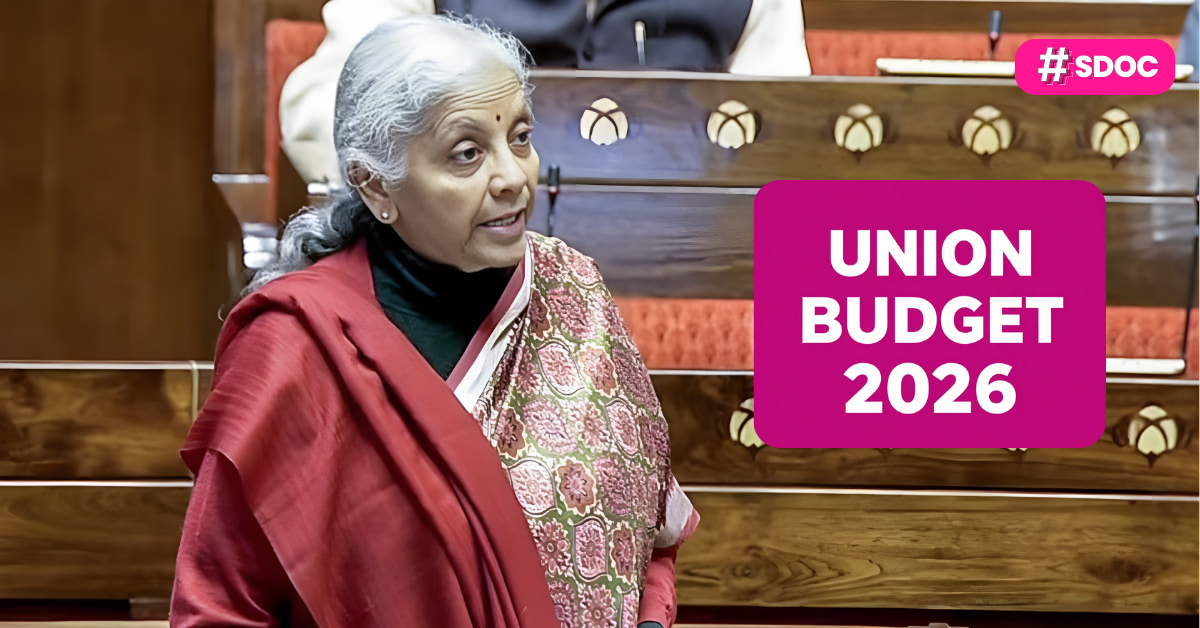
Finance Minister Nirmala Sitharaman presented the Union Budget 2026–27 in Parliament on Saturday, striking a careful balance between growth-driven spending and fiscal discipline. The budget makes it clear that the government’s focus remains on infrastructure, manufacturing, technology, and long-term economic stability, even as global uncertainties persist.
A Snapshot of the Numbers
The total expenditure for FY27 has been pegged at around ₹53.5 lakh crore, while non-debt revenue receipts are estimated at ₹36.5 lakh crore. The government has set a fiscal deficit target of 4.3% of GDP, reinforcing its commitment to gradual consolidation. Nominal GDP growth for the year is projected at nearly 10%, signalling confidence in India’s domestic demand and investment momentum.
Infrastructure Takes Centre Stage
One of the biggest highlights of the budget is the record capital expenditure allocation of ₹12.2 lakh crore, an increase of over 11% compared to the previous year. The government announced new investments across roads, railways, logistics, and urban infrastructure. Plans for multiple high-speed rail corridors and expanded freight capacity are expected to create jobs, boost productivity, and crowd in private investment.
Manufacturing, Semiconductors and MSMEs
In line with its ‘Make in India’ push, the budget places strong emphasis on domestic manufacturing. The launch of Semiconductor Mission 2.0, with an outlay of ₹40,000 crore, aims to position India as a global chip manufacturing and design hub. MSMEs also received support through expanded credit guarantees and targeted funding, recognising their role as the backbone of employment generation.
Health, Innovation and Social Development
The government announced Biopharma Shakti, a ₹10,000 crore initiative to strengthen India’s pharmaceutical and biotechnology ecosystem, including R&D and manufacturing capacity. On the social front, allocations were made for women’s hostels, education infrastructure, healthcare access, and clean mobility initiatives such as electric buses, signalling a continued focus on inclusive growth.
Taxes: Stability Over Surprises
For individual taxpayers, the budget brought relief in the form of stability. There were no changes to income tax slabs, reducing uncertainty for the middle class. On the investment side, norms for NRI investments were liberalised, with limits increased to encourage greater capital inflows into Indian markets.
Defence and Strategic Spending
Defence expenditure saw a meaningful rise, crossing ₹7.8 lakh crore, with a clear push towards modernisation and indigenous defence manufacturing. This aligns with India’s broader goal of strategic self-reliance.
The Big Picture
Calling the budget “human-centric,” Prime Minister Narendra Modi emphasised its long-term vision. Overall, the Union Budget 2026–27 avoids populism, prioritises capital creation, and reinforces confidence in India’s economic trajectory. For businesses, founders, and investors, the message is clear: growth will be driven by infrastructure, innovation, and disciplined policymaking, not short-term fixes.
Keep building. Keep learning. Keep growing with StartupByDoc.