

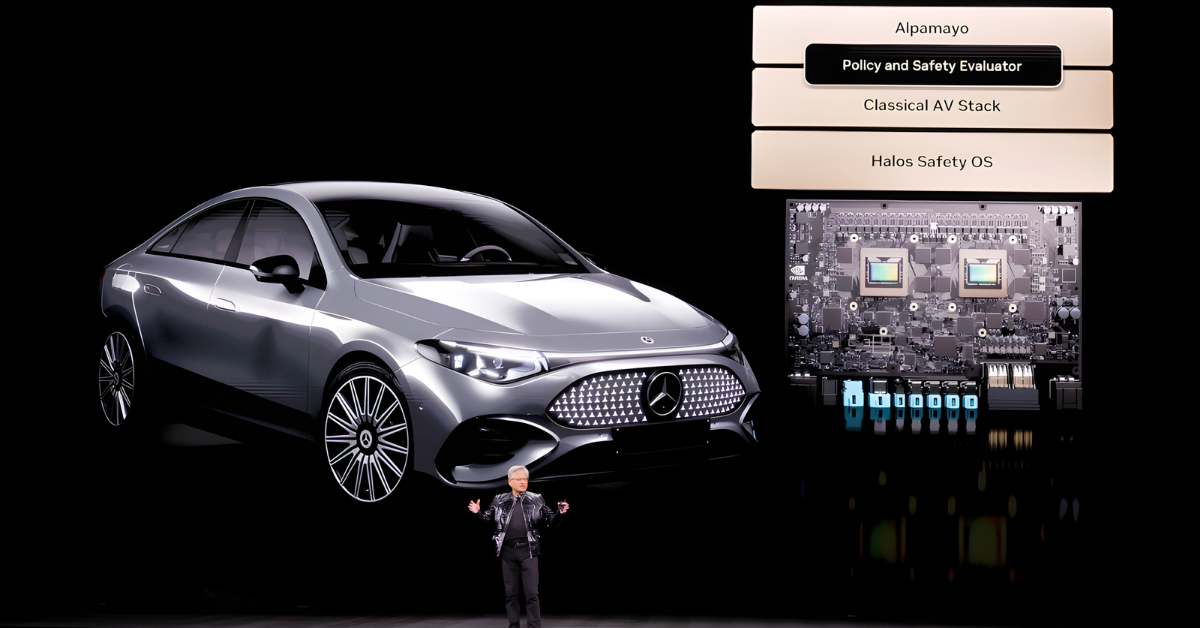
Announcement at CES 2026
Nvidia chief executive officer Jensen Huang on January 5 outlined the company’s plans to accelerate development of technologies for autonomous vehicles and robotics, signalling a major expansion beyond its core artificial intelligence business. The announcement was made during Huang’s keynote address at the CES trade show in Las Vegas.
Alpamayo Vehicle Platform
At the event, Huang introduced a new vehicle platform called Alpamayo, designed to enable cars to “reason” in real-world environments. According to reports, Alpamayo processes inputs from cameras and sensors, breaks down complex scenarios into steps and generates responses to navigate unexpected situations. Nvidia said the base Alpamayo model will be made available free, allowing developers and automakers to retrain it for specific use cases.
Autonomous Driving Focus
Huang said robotics, including autonomous vehicles, represents Nvidia’s second most important growth area after AI. He outlined a long-term vision where autonomous systems become mainstream, stating that future vehicles could either operate as robotaxis or be owned privately by consumers.
Testing and Deployment Timeline
Nvidia is targeting early testing of its autonomous vehicle technology from 2027. The company is working with Mercedes-Benz to develop vehicles capable of hands-free highway driving and urban navigation. Huang said the first Nvidia-powered vehicles are expected to roll out in the United States in the first quarter, followed by Europe in the second quarter and Asia in the second half of the year. Consumer vehicles with point-to-point self-driving features are being targeted for 2028.
Robotaxi and Robotics Push
The company has also expanded partnerships in the autonomous mobility space, including a robotaxi collaboration with Uber announced in October 2025. Separately, Nvidia is developing AI models for robots and is working with Siemens AG to bring AI-driven intelligence into industrial and physical-world applications.
Strategic Context
The announcements underline Nvidia’s ambition to extend its AI leadership into transportation and robotics, as global automakers and technology firms race to commercialise autonomous systems.
Keep building. Keep learning. Keep growing with StartupByDoc.