

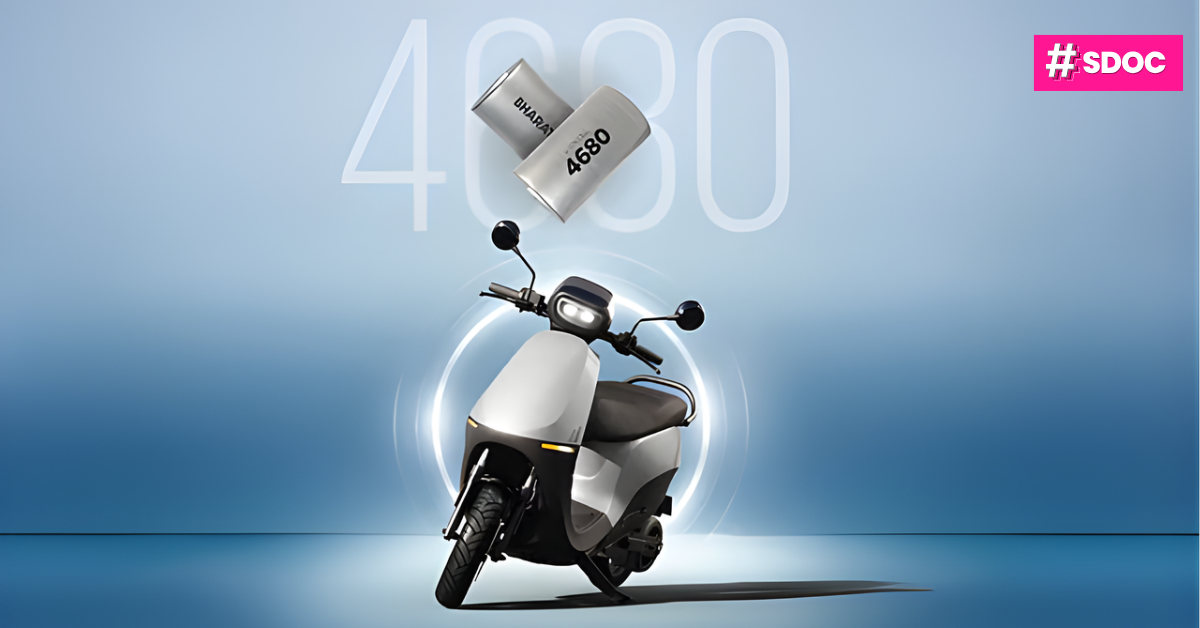
Ola Electric has launched the S1 X+ electric scooter with a 5.2 kWh battery pack, aiming to expand access to long-range electric mobility in the mass-market segment.
The new model is powered by the company’s in-house 4680 “Bharat Cell”, marking a significant step in Ola’s strategy to localise battery production and reduce dependence on imported components.
In-House Battery Push to Improve Costs and Margins
The 4680 Bharat Cell is a lithium-ion cell format developed internally, allowing Ola Electric to control a larger portion of its supply chain. This aligns with its long-term plan to manufacture batteries domestically at its Krishnagiri facility.
If scaled effectively, in-house cell production could help the company lower battery costs — the largest component in EV pricing — and improve margins while offering competitive pricing in a price-sensitive market.
Market Pressure Intensifies Despite EV Growth
The launch comes at a challenging time for Ola Electric, which has seen a sharp decline in market share. Its retail sales dropped over 52% to 1.64 lakh units in FY26 from 3.44 lakh units in FY25, even as overall EV penetration rose to 6.5% and volumes grew 21.8%.
Meanwhile, rivals such as TVS Motor Company, Bajaj Auto, and Ather Energy have gained ground with strong growth in sales.
Pricing and Competitive Positioning
Priced at an introductory ₹1,29,999, the S1 X+ competes directly with models like TVS iQube, Ather 450X, and Bajaj Chetak in the ₹1–1.5 lakh segment.
The launch reflects Ola’s broader strategy of leveraging vertical integration across battery technology, engineering, and manufacturing to scale innovation. However, the real test will lie in performance, cost efficiency, and large-scale production of its in-house cells.
Keep building. Keep learning. Keep growing with StartupByDoc.