

In many rural and semi-urban schools across India, teaching still competes with paperwork. Attendance registers are manual. Fee records sit in physical files. Communication flows through fragmented messaging apps. Teachers often spend more time managing operations than mentoring students.
This operational imbalance rarely makes headlines, but it shapes student outcomes every day.
A Founder’s Realisation and the Birth of Inkrant
The founder, a Computer Science graduate who completed his Master’s degree in the United States, began reflecting on his own academic journey. He recognised that his growth was shaped by teachers who had the time to guide him.
However, in many Indian schools, teachers are overburdened with attendance registers, reporting formats, fee tracking, and parent communication. A Children’s Day memory reinforced the insight: educators constantly working behind the scenes to keep systems functional.
Instead of launching another content-driven EdTech platform, he chose to solve an operational problem. Inkrant was built to reduce administrative load and give time back to teachers.
Building a Unified AI SaaS for Rural and Semi-Urban India
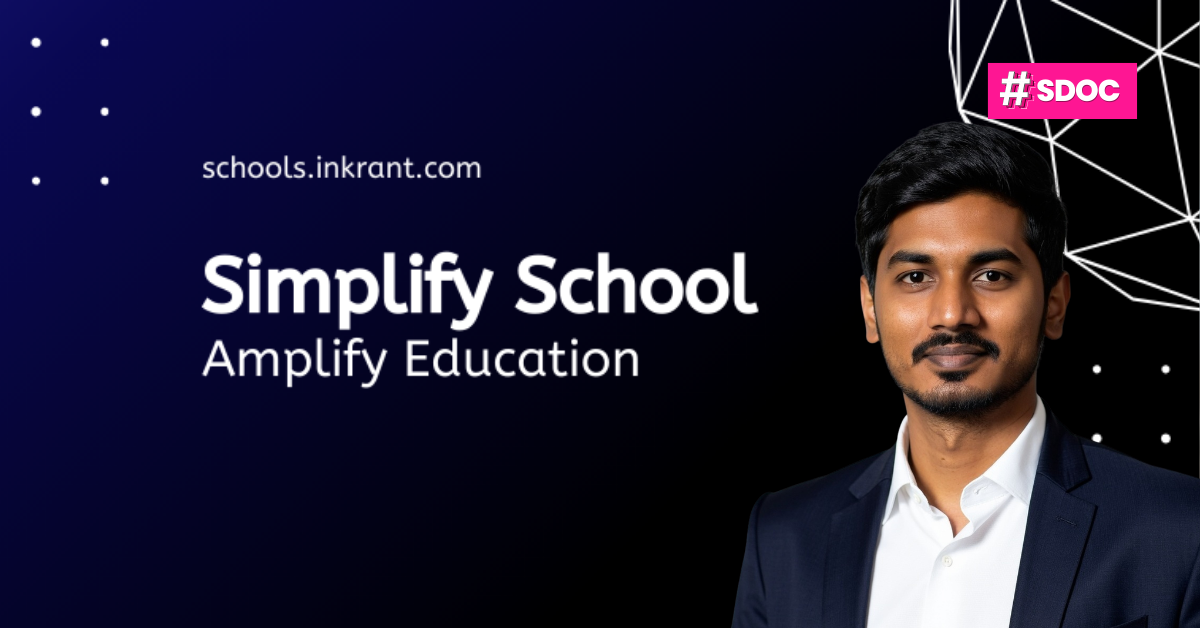
Inkrant launched as an AI-powered vertical SaaS platform focused on digitising entire school ecosystems. Its flagship product, Schools by Inkrant, integrates attendance, academics, communication, fee management, and reporting into one unified system .
The company also introduced Career AI, enabling students to identify long-term goals early and align academic pathways accordingly .
Crucially, the startup targeted rural and semi-urban schools — institutions still dependent on paperwork and fragmented digital tools . The platform has completed development and functional validation, and has entered live onboarding and pilot implementation phases .
Rather than positioning AI as disruption, Inkrant positioned it as infrastructure.
Strategic Lessons for Early-Stage Indian Founders
Three strategic decisions shaped Inkrant’s direction:
- Building a unified ecosystem instead of offering fragmented solutions
- Prioritising operational automation before advanced analytics
- Entering underserved geographies where digitisation gaps are structural
In India’s context, distribution in rural markets demands patience. Trust-building requires founder involvement. Pricing sensitivity influences product architecture. But startups that embed themselves into daily workflows create long-term defensibility.
Inkrant’s journey is not defined by hyper-growth metrics, but by system-level integration. In education, sustainable impact often comes from solving operational friction before chasing scale.
Keep building. Keep learning. Keep growing with StartupByDoc.