

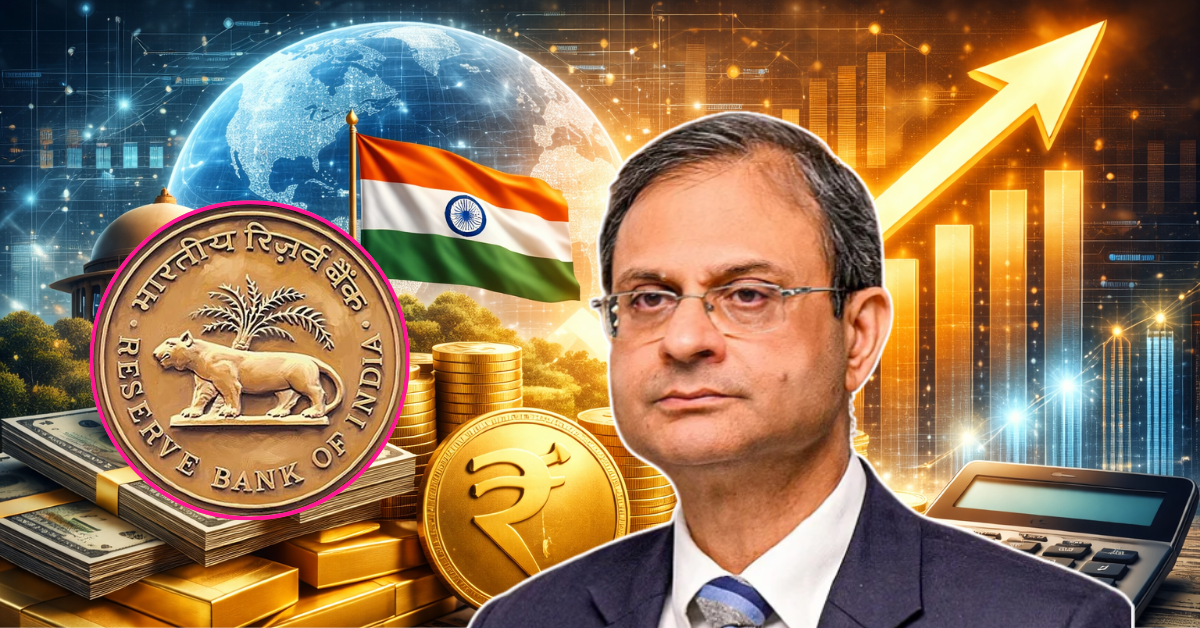
India’s foreign exchange reserves stood at $723.8 billion as of end-January 2026, reinforcing the country’s strong external sector position, Reserve Bank of India (RBI) Governor Sanjay Malhotra said during the latest Monetary Policy Committee (MPC) briefing.
The elevated reserve levels come at a time of heightened global uncertainty, marked by volatile capital flows, geopolitical tensions, and shifting monetary policy expectations across advanced economies.
Strong External Buffer Amid Global Uncertainty
Speaking after the policy announcement, Governor Malhotra said India’s robust forex reserves provide a critical buffer against external shocks and enhance the central bank’s ability to manage volatility in the foreign exchange market. He added that the reserve position reflects prudent macroeconomic management and sustained confidence among global investors in India’s economic fundamentals.
India’s forex reserves include foreign currency assets, gold holdings, Special Drawing Rights (SDRs), and the country’s reserve position with the International Monetary Fund (IMF). The RBI actively manages these assets with a focus on safety, liquidity, and long-term stability, while intervening in the currency market only to prevent disorderly movements.
What the Reserve Build-Up Signals
Economists view the current level of reserves as providing comfortable import cover and strengthening India’s capacity to meet external payment obligations even during periods of global stress. A strong reserve position also helps lower external vulnerability and supports financial stability, particularly for emerging markets exposed to sudden capital flow reversals.
Over the past year, India’s forex reserves have been supported by steady capital inflows, resilient services exports, and calibrated RBI intervention aimed at smoothing excessive currency volatility rather than targeting specific exchange rate levels.
Policy Flexibility and Investor Confidence
The strong forex buffer gives policymakers greater flexibility in navigating global headwinds without compromising domestic growth priorities. It also bolsters investor confidence at a time when global risk appetite remains uneven and financial conditions are tightening in several major economies.
Governor Malhotra reiterated that the RBI remains focused on its core mandate of price stability, while supporting growth and safeguarding financial stability. He said the central bank will continue to closely monitor global developments and external sector risks as part of its policy framework.
With reserves near record highs, India is seen as better positioned than many peers to withstand external shocks, underscoring the growing resilience of its macroeconomic and financial architecture.
Follow Startupbydoc for daily startup insights, funding news, IPO analysis, and business breakdowns.