

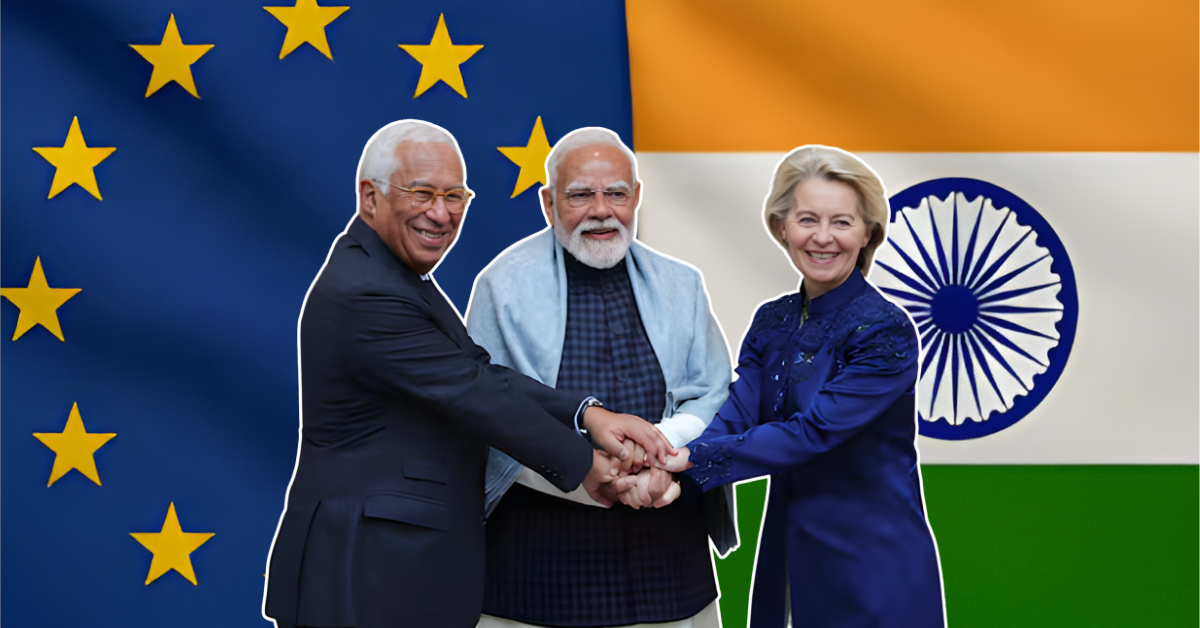
Indian electronics manufacturers are set to gain preferential access to the European Union’s nearly $750 billion electronics market under a proposed India-EU trade agreement, a move that could significantly accelerate India’s ambitions to become a global electronics manufacturing hub.
Industry estimates suggest that Indian companies could export up to $50 billion worth of electronics to the EU by 2031, provided the agreement is finalised and implemented as expected. The deal is also likely to give Indian manufacturers cheaper and easier access to advanced European machinery, equipment and production technologies, which are critical for scaling up complex electronics manufacturing.
The proposed agreement with the European Union is expected to reduce or eliminate tariffs on a wide range of electronic products, while also simplifying regulatory and conformity requirements. This would make Indian exports more competitive in the EU, one of the world’s largest and most regulated consumer markets.
Boost to High-End Manufacturing
Beyond market access, a key benefit for Indian manufacturers will be improved access to high-end European capital goods, including semiconductor fabrication equipment, precision tooling and advanced automation systems. These technologies are essential for producing complex electronics, industrial components and high value consumer devices.
Industry executives say the availability of such machinery at lower costs could help Indian firms move up the value chain from assembly-led manufacturing to design intensive and technology-driven production.
Alignment With India’s Manufacturing Push
The development aligns closely with India’s broader manufacturing strategy, including incentives under the Production Linked Incentive (PLI) schemes, which aim to expand domestic electronics output and reduce import dependence.
Electronics is already one of India’s fastest growing export segments, driven by smartphones, consumer electronics and industrial equipment. Preferential access to the EU market could further diversify export destinations beyond the US and Asia.
Strategic and Geopolitical Context
Analysts view the proposed deal as part of a wider effort by both India and the EU to de-risk supply chains, reduce over dependence on a limited number of manufacturing geographies, and strengthen trade ties amid global geopolitical uncertainty.
If concluded, the agreement could mark a structural shift in India–EU trade, positioning Indian electronics manufacturers as long-term partners in Europe’s supply ecosystem rather than just low cost suppliers.
Follow Startupbydoc for daily startup insights, funding news, IPO analysis, and business breakdowns.