

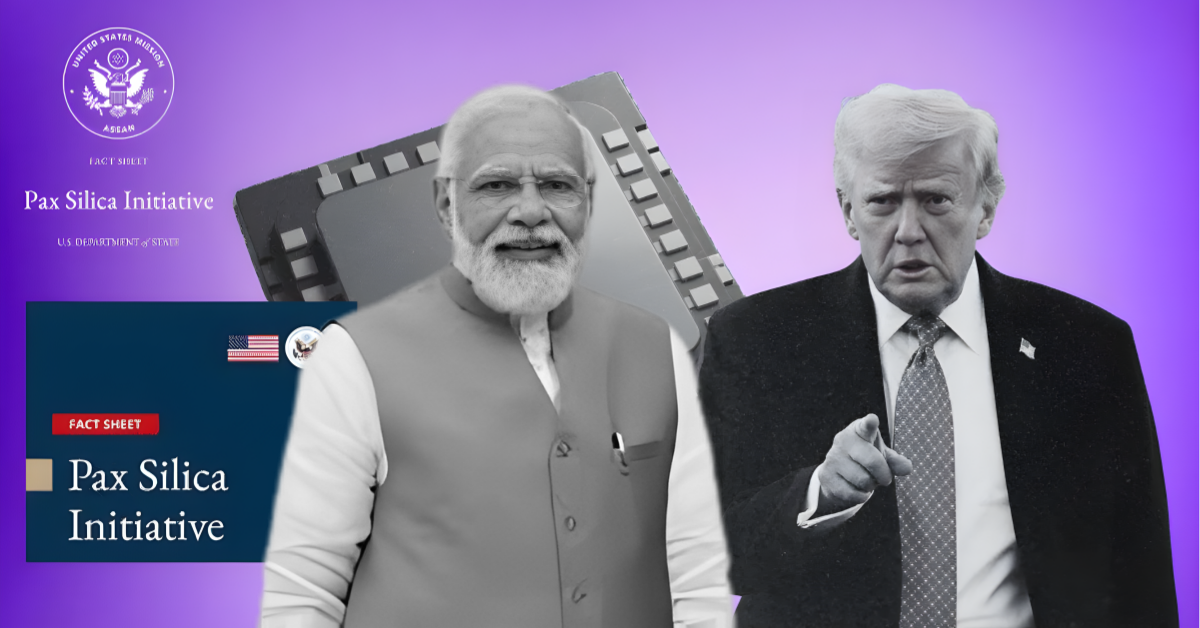
The United States has unveiled a nine-nation strategic coalition to strengthen the global semiconductor and artificial intelligence (AI) supply chain, with India notably absent from the initiative.
The alliance, dubbed “Pax Silica,” includes Japan, South Korea, Singapore, the Netherlands, the United Kingdom, Israel, the United Arab Emirates, and Australia, according to a statement from the US Department of State. The group aims to build a secure, resilient, and innovation-driven silicon ecosystem, spanning critical minerals, advanced chip manufacturing, AI infrastructure, and global logistics.
“These countries host the most influential companies and investors driving the global AI supply chain,” the State Department said, adding that the initiative seeks to reduce coercive dependencies, protect critical technologies, and enable large-scale deployment of next-generation innovations.
India’s exclusion stands out, especially as the country is actively developing an indigenous semiconductor ecosystem. Under the $10 billion India Semiconductor Mission (ISM) announced in 2021, the government has approved 10 projects worth ₹1.6 trillion, covering chip fabrication, packaging, and testing. India also plays a significant role in global chip design, with a large base of semiconductor engineers.
Beyond chips, India is accelerating its AI ambitions through the ₹10,372 crore IndiaAI Mission, focused on building homegrown large language models and expanding access to graphics processing units (GPUs). The country’s total GPU capacity has nearly doubled to 34,333 units, strengthening cloud-based compute infrastructure critical for AI training and inference.
While Pax Silica signals a tightening of strategic technology partnerships among US allies, India continues to pursue a self-reliant semiconductor and AI roadmap, positioning itself as a long-term player in the global technology supply chain.
For more deep-tech policy insights and startup intelligence, follow StartupByDoc.